

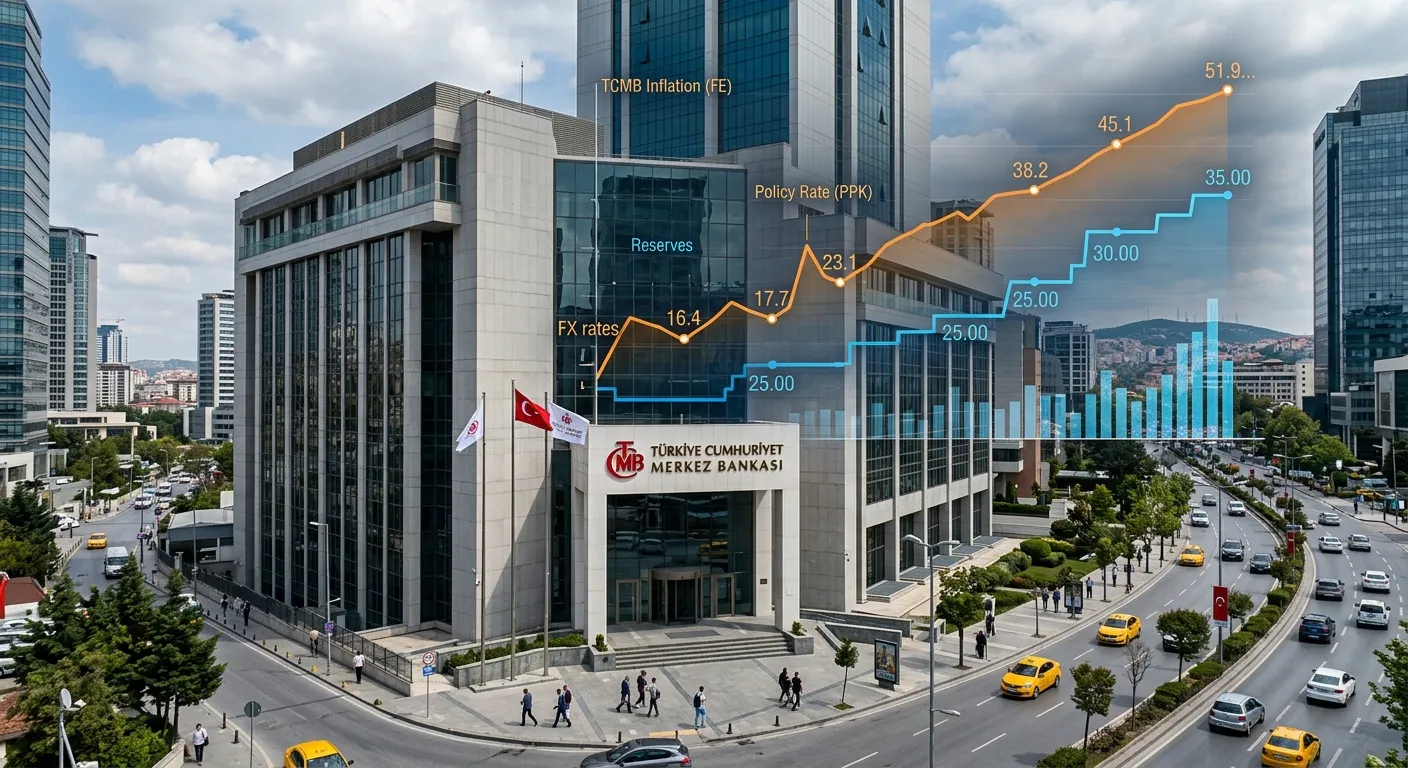
The Central Bank of the Republic of Turkey (CBRT) has officially revised its Turkey inflation forecast 2026 upward to 28%, shifting away from the previous projection of 26%. This significant adjustment by economic policymakers reflects mounting pressures from global commodity and energy markets, which continue to challenge domestic price stability. Despite the upward revision in the headline year-end expectation, financial authorities have emphasized their unwavering commitment to monetary tightening to anchor long-term economic equilibrium.
- Turkey raised its end-2026 inflation forecast to 28% from 26%.
- The revision is driven by higher underlying assumptions for import prices.
- Interim targets remain unchanged at 24% for 2026 and 15% for 2027.
- The Central Bank continues its firm stance on tight monetary policy.
Turkey Revises 2026 Inflation Forecast Upward
In its latest economic outlook presentation, the Central Bank of the Republic of Turkey announced that the projected inflation rate for the end of 2026 would climb to 28%. According to financial reports published by investing experts, monetary authorities had to recalibrate their models to account for persistent external cost pressures that threaten to spill over into domestic consumer prices. Analysts note that managing external vulnerabilities remains a cornerstone of broader financial stability in the region, paralleling trends seen across other major sectors like Turkey Tourism Revenue Reaches $25.7B in H1 2026, where macroeconomic resilience plays a vital role in cushioning against external market volatility.
Key Drivers Behind the Import Price Increases
Why did the Turkish Central Bank raise its inflation forecast? The primary catalyst behind this upward adjustment is the notable increase in baseline assumptions regarding vital import costs. Specifically, the central authority pointed to higher projected prices for essential commodities, including diesel, natural gas, and broader raw materials on global markets. As a net energy importer, Turkey remains particularly vulnerable to shifts in international energy valuations, which directly feed into transportation, manufacturing, and household utility expenses.
Commitment to Tight Monetary Policy Remains Firm
To counteract these inflationary headwinds, the Turkish Central Bank monetary policy framework remains aggressively focused on demand management. Policymakers have reiterated that interest rates and lending conditions will stay restrictive for as long as necessary to secure a permanent downward trend in consumer price growth.
Interim Targets for 2026 and 2027
Even with the revised year-end forecast, the CBRT has preserved its strategic medium-term trajectory. Financial planners are monitoring specific benchmark figures to evaluate progress across upcoming fiscal cycles.
| Metric / Indicator | Previous Projection | Revised / Maintained Target |
|---|---|---|
| 2026 Headline Inflation Forecast | 26% | 28% |
| 2026 Interim Inflation Target | 24% | 24% |
| 2027 Interim Inflation Target | 15% | 15% |
As illustrated in the framework above, the interim targets stand firm at 24% for the end of 2026 and 15% for the conclusion of 2027, demonstrating that the underlying disinflation path remains structurally intact despite short-term external shocks.
Broader Economic Implications and Fiscal Coordination
To ensure that long-term price stability is successfully achieved, monetary tightening is being closely coordinated with broader macroeconomic strategies. Economic policymakers recognize that tackling inflation requires a multi-faceted approach involving disciplined fiscal measures and structural reforms. By maintaining tight lending conditions and discouraging excessive domestic demand, the Central Bank aims to prevent inflationary expectations from becoming entrenched in everyday business pricing behavior. Furthermore, international financial observers continue to monitor these developments closely, noting that persistent policy discipline will be vital for restoring investor confidence and reducing long-term borrowing costs across the Turkish financial ecosystem.